
Equity can be Shareholders’ Equity, Stockholders’ Equity, or Owner’s Equity. If the left side of the accounting equation (total assets) increases or decreases, the right side (liabilities and equity) correct accounting equation also changes in the same direction to balance the equation. The accounting equation equates a company’s assets to its liabilities and equity.
Equity
It also minimizes the chance of steps being skipped under pressure. Bank reconciliations, loan schedules, and inventory counts are your first line of defense against hidden discrepancies. Regular reconciliation keeps your records clean and your reports trustworthy. This could be a loan from the bank, Oil And Gas Accounting unpaid vendor bills, or taxes due.
Corporation Transaction C8.
Now look at Year 2, where Property, Plant & Equipment jumps to $491,161, while Short-Term Debt drops to just $19,978 and Long-Term Debt increases significantly to $217,197. This tells you the business likely took out a long-term loan to invest in fixed assets. Now, the business owner contributes $5,000 in cash to get things started. This is known as owner’s capital or owner’s equity, and it’s the first transaction you record. Equity represents the owner’s or shareholders’ claim on the business after liabilities are subtracted from assets.

Shareholders’ Equity
Individual transactions which result in income and expenses being recorded will ultimately result in a profit or loss for the period. The term capital includes the capital introduced by the business owner plus or minus any profits or losses made by the business. Profits retained in the business will increase capital and losses will decrease capital. The accounting equation will always balance because the dual aspect of accounting for income and expenses will result in equal increases or decreases to assets or liabilities.
- After almost a decade of experience in public accounting, he created MyAccountingCourse.com to help people learn accounting & finance, pass the CPA exam, and start their career.
- A debit refers to an increase in an asset or a decrease in a liability or shareholders’ equity.
- Effective management of aspects such as debt and receivables is vital since it impacts how debit transactions are reflected under the owner’s equity.
- By understanding the relationship between assets, liabilities, and equity, businesses can ensure their financial records are accurate and balanced.
- Its Cash Management module automates bank integration, global visibility, cash positioning, target balances, and reconciliation—streamlining end-to-end treasury operations.
- Get instant access to video lessons taught by experienced investment bankers.
- Equity components include capital contributed by owners, retained earnings, and common stock.
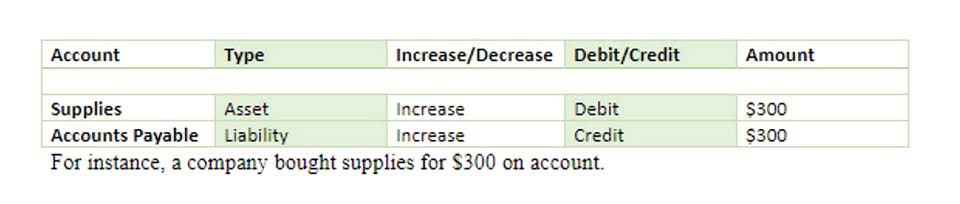
- This could be a loan from the bank, unpaid vendor bills, or taxes due.
- Non-current assets include property, equipment, and intangible assets like patents.
- The accounting equation ensures that the balance sheet remains balanced.
- A recap of these changes is the statement of changes in owner’s equity.
Starting at the top of the statement we know that the owner’s equity before the start of 2024 was $60,000 and in 2024 the owner invested an additional $10,000. As a result we have $70,000 before considering the amount of Net Income. We also know that after the amount of Net Income is added, the Subtotal has to be $134,000 (the Subtotal calculated in Step 4). The totals tell us that as of midnight on December 6, the company had assets of $17,200.

Transaction Matching
On the basis of this dual nature of transactions, modern accountants have developed net sales a mathematical formula that is referred to as the accounting equation. While the accounting equation is a fundamental concept, the balance sheet is a practical application of this equation, providing detailed information about each component. To produce the balance sheet at the end of the period, all transactions are processed for each line item. For a start-up business, the beginning amounts for all accounts are zero. The cumulative impact of all the additions and subtractions gives the ending amount, which appears in the balance sheet at the end of the period.

How to Fill Out a Money Order for Child Support
A debit refers to an increase in an asset or a decrease in a liability or shareholders’ equity. A credit in contrast refers to a decrease in an asset or an increase in a liability or shareholders’ equity. Shareholders’ equity is the total value of the company expressed in dollars. It’s the amount that would remain if the company liquidated all its assets and paid off all its debts. The remainder is the shareholders’ equity which would be returned to them.